Newsletter August 2026

August 2026
Welcome to Our August 2026 Newsletter!
Dear Clients, company owners, and sole traders;
With August in full swing, we can almost hear you thinking, "Time to put my feet up and enjoy a quiet cuppa." Unfortunately, HMRC doesn’t do summer holidays! So, to save you from digging through tax codes while trying to enjoy the sunshine, we’ve rounded up the essential UK tax and compliance updates for you.
Here are the big highlights landing on your desk this month:
- Making Tax Digital Has Officially Landed: Over 436,000 sole traders and landlords successfully filed their first quarterly updates. If you missed the deadline, don’t panic, it’s a penalty free transition year, but HMRC will start auto enrolling eligible businesses from September.
- Employment Law Shifts: The Employment Rights Act 2025 details are being finalized, bringing clearer rules around zero-hours contracts and shift notices.
The Big Summer Warning: Don’t Ignore Those "Simple Assessment" Notices!
HMRC is currently dropping Simple Assessment letters into post-boxes across the UK for individuals with untaxed income from the 2025–2026 tax year.
Our strongest piece of advice? Resist the urge to slide that brown envelope under a pile of mail with a promise to "look at it after the holiday." The tax office isn't known for its sense of humour, and an ignored notice can quickly turn into a headache of interest and penalties come autumn.
Open it, double-check the figures, or better yet, pass it straight to us and let us handle it for you.
Check out the rest of the newsletter below for the full breakdown.
Wishing you a profitable and stress-free September!
Net Accounting Ltd
Sole Traders and Landlords successfully submit first Making Tax Digital
Over 436,000 sole traders and landlords have submitted their first Making Tax Digital for Income Tax quarterly update for the 2026-2027 tax year. Those who haven't yet submitted can do so now without penalties this year. Starting in September, HMRC will begin enrolling customers who need to use Making Tax Digital for Income Tax for that tax year but have not yet signed up.
HMRC warns: Don’t ignore Simple Assessment notices this Summer
HMRC will send Simple Assessment letters this summer for the 2025-2026 tax year to individuals with untaxed income. Recipients are advised not to ignore these letters.
The Government’s plan to replace ‘flexible chaos’ with secure, predictable work
The government’s manifesto aimed to improve job security by ending one-sided flexibility and ensuring all jobs offer stability and predictability. To achieve this, the Employment Rights Act 2025 introduces three new employee rights:
- guaranteed hours based on actual work,
- reasonable notice for shift changes, and
- compensation for short-notice cancellations or modifications.
HMRC’s Capital Gains Manual update sparks hope for thousands of landlords
HMRC has amended its Capital Gains Manual regarding the 20-hour test for Incorporation Relief, confirming that individuals spending fewer than 20 hours weekly on property activities can still conduct a business under section 162 of the Taxation of Chargeable Gains Act 1992.
The amendment acknowledges that while 20 hours can indicate substantial engagement, landlords contributing less time can still be recognized as operating a business. The guidance change ensures that considerations of business status focus on the entirety of activities rather than a strict hourly metric.
HMRC release new tool to check tax filing and payment deadlines
Check your tax filing and payment deadlines tool provided by HM Revenue and Customs (HMRC). This interactive service lets you calculate key dates for multiple taxes and add them directly to your electronic calendar.
Newsletter July 2026

July 2026
Welcome to your July 2026 update!
Grab yourself a cup of tea, settle in, and let’s dive into what’s happening. As usual, the UK tax and accounting world has been far from quiet this month! In this issue, we’re breaking down the latest updates across tax, payroll, economy, and Self-Assessment that directly affect you and your business.
First up, the headline news (and let’s be honest, the one most likely to cause a slight headache): if you’re a sole trader or a landlord with an annual income over £50,000, Making Tax Digital (MTD) for Income Tax is officially moving into top gear. The days of filing your return once a year and forgetting about it until the next are drawing to a close. HMRC now wants a quarterly update using approved software.
We completely get it, going from one deadline a year to four sounds like a right pain, and keeping up with digital records every three months is bound to bring a few extra chores to your plate as well as ours. But don’t panic! We’re not here just to break the news, we’re here to take that weight off your shoulders and make the transition as smooth and hassle free as possible.
Further down, you’ll also find key updates on the future of Self-Assessment payments, new compliance rules, and major consultations affecting company distributions.
Take a breath, relax, and read on, we’ve got your back!
Warm regards,
Net Accounting Ltd
Timely payments in Income Tax Self-Assessment
HMRC reports that the current system has been found to result in ~one in five Income Tax Self-Assessment tax bills paid late. From 2029, taxpayers will be required to pay towards their Self-Assessment tax bill through their regular PAYE payments, rather than in one bulk payment after the tax return is filed. HMRC will use your most recent tax return to forecast your payments and update your tax code.
Introducing a criminal offence for making reckless and untrue statements
Taxpayers and their agents who declare false information or fail to file a return to HMRC in relation to direct tax matters could be subject to imprisonment and/or fines under the Government's proposals. The offence would be committed where a “statement” or “declaration” is made that is “untrue”, and the maker of the statement has acted “recklessly”.
Sole traders and landlords with income of £50K will have to submit updates every three months
As part of the Making Tax Digital (MTD) scheme, landlords and self-employed individuals earning over £50,000 must submit quarterly records to HMRC using approved software. From April 2027, those with incomes over £30,000 will also need to comply, followed by those earning over £20,000 in 2028.
Major Consultation: Modernising Tax on Company Distributions
Launched in June 2026, this wide-ranging consultation explores fundamental changes to how companies return capital to shareholders. The proposals include "freezing" capital on shares to prevent extracting profits at capital gains rates rather than income rates, as well as reforms to demerger relief and share buybacks. This is particularly impactful for owner-managed businesses and shareholders planning to exit or restructure. The consultation closes on 14 September 2026.
HMRC Cryptoasset Compliance Campaign
HMRC has launched a "one-to-many" campaign targeting individuals who may have underpaid tax on cryptoasset transactions. Taxpayers may be contacted via letter, email, or SMS and encouraged to disclose unpaid Income Tax or Capital Gains Tax. New reporting boxes for crypto gains are included in recent tax returns, and failure to report accurately can lead to penalties of up to 100% of the tax due.
Newsletter June 2026

June 2026
Welcome to the June edition of our monthly roundup!
If you are currently wondering how on earth we have already sprinted past the mid-year mark, you are certainly not alone. If you’re also wondering why your to-do list seems to grow faster than you can tick things off, well, that’s just the small business experience, isn’t it?
But fear not, while you’ve been busy keeping your business afloat, the tax and legislative landscape has been doing its usual dance moves.
This month, there are a few key developments you’ll want to be across. First, the good news: the approved mileage rate increase (backdated to April) is finally putting a bit more back in your pocket if you’re out on the road. There is also the looming P11D deadlines (nobody wants a July 6th panic) and offering a collective deep breath regarding the ongoing rollout of Making Tax Digital (MTD).
The Bank Rate, on the other hand, has maintained at 3.75%, leaving small firms to navigate a near 17% rise in outgoings over the past year. Meanwhile, employers are preparing for upcoming compliance challenges like the 6-month probation and Statutory Sick Pay adjustments under the Employment Rights Act.
However, the biggest headline shaking up our inboxes this month is the Companies House Accounts Filing Reforms 2028. We know many of you received an official email from the government outlining these changes, and a wave of collective panic immediately followed. The notification explained that under the Economic Crime and Corporate Transparency Act 2023, small companies and micro-entities will eventually be required to file full profit and loss accounts through commercial software.
But please, step away from the panic button! First of all, the implementation date has been pushed back to April 2028, giving you plenty of time to prepare. More importantly, while submitting a profit and loss account will become mandatory, having that information published on the public register is entirely optional. You can choose to opt out of public disclosure to protect your commercial privacy. So take a deep breath, ignore the ominous notifications, and let us handle the paperwork.
We have always got your back!
Warm regards,
Net Accounting Ltd
Warning regarding tax fraud — there are attempts to utilize 'Bills of Exchange' for payments to HMRC
HMRC has issued a warning about a fraudulent 'payment model' involving Bills of Exchange for settling tax liabilities. A Bill of Exchange, as per the Bills of Exchange Act 1882, is not an obligatory form of payment, and HMRC does not accept it against tax debts. This scheme is being marketed to employers, particularly in recruitment and temporary labour sectors, but can target any business.
Update on the changes to accounts filing
Th Update on the changes to accounts filing e government announced reforms under the Economic Crime and Corporate Transparency Act 2023 for how companies report their annual accounts. Key changes include requiring small companies to file profit and loss accounts, using commercial software for filings, and removing abridged accounts. These reforms start in April 2028, giving companies time to prepare. Small companies can opt out of publishing profit and loss accounts while still allowing access for enforcement agencies.
HMRC crackdown targets criminals exploiting the high street
HMRC will carry out more than 30,000 interventions this year to tackle tax fraud and illegal activity on the high street. Action targets organised crime groups and others exploiting vape shops, barbers and convenience stores in hotspot areas.
HMRC doubles funding for customers who need extra support
HM Revenue and Customs (HMRC) is offering over £11 million in funding for voluntary and community sector organizations to help customers with tax affairs starting from April 2027. Applications are open until July 3rd, with grants available for tailored support to those facing tax-related challenges. Successful organizations will partner with HMRC for three years to assist customers effectively.
Newsletter May 2026

May 2026
Welcome to your May 2026 financial brief!
If April’s pollen didn't make you cry, checking your business cash flow might have. But don't worry, while the UK economy keeps throwing surprises, we are here to help you nail them. From fresh legislative crackdowns to shifts in your future retirement plans, this month is packed with compliance updates that every UK small business owner and sole trader needs to know.
Here is a quick look at what we are diving into this month:
Initially we explore the landmark Small Business Protections Bill, a massive crackdown targeting late payments. If you are tired of chasing invoices, you will want to read about the new mandatory 60 day payment rule for large firms and the hefty 8% penalty interest rate.
HMRC is also testing a new Targeted Advance Assurance Service. This pilot scheme is designed to give SMEs early guidance on complex or high-risk claims before hitting submit.
Companies House, on the other hand, has temporarily paused deleting records for dissolved companies while they review their retention periods.
Are you operating from sunny shores? Be aware that the option to pay voluntary Class 2 National Insurance contributions while abroad was officially removed on 6 April.
Finally, we look at the government's targeted fuel package to combat rising pump prices, and a sobering report warning that nearly half of us are under saving for retirement.
Grab a strong coffee, and let's get you compliant!
Warm regards,
Net Accounting Ltd
Companies House reviews retention period for dissolved company records
Companies House has temporarily halted the destruction and transfer of records for dissolved companies as it evaluates the necessity of extending the existing 20-year retention period.
Payroll Processing
Late payments bill introduced to parliament
The Small Business Protections Bill has been introduced by the Government to combat late payments, which close 38 businesses daily. This legislation mandates large firms to pay smaller suppliers within 60 days and imposes a penalty interest of 8% above the Bank of England base rate for late payments.
47% of employees are not adequately saving for their retirement
Nearly half of working adults in the UK, especially those born between 1965 and 1980, are not saving for pensions, with 45% of all adults failing to contribute at all. The Pension Committee's interim report highlights declining defined benefit schemes and low savings rates. Many in Generation X lost opportunities for savings due to shifts in pension types. Recommendations for improvement will be released in Spring 2027.
Targeted Advance Assurance Service for R&D claims introduced
HMRC has launched a new targeted advance assurance service for Research & Development (R&D) tax relief claims, following proposals announced in Budget 2025. Introduced initially as a pilot scheme, the service is designed to help Small and Medium-sized Enterprises (SMEs) gain greater certainty before submitting an R&D claim. It aims to provide early guidance on complex or higher-risk areas, helping businesses better understand eligibility and reduce uncertainty during the claims process.
Voluntary National Insurance contributions abroad
From 6 April 2026, for tax years 2026 to 2027 onwards, the option to pay voluntary Class 2 National Insurance contributions for periods abroad was removed.
Government takes measures to protect drivers and businesses from rising fuel costs
Britain’s motorists and businesses will get help with rising prices at the pumps with a targeted package to keep taxes down and support people with the impact of war in Iran.
Newsletter April 2026
April 2026
Welcome to Your April 2026 Tax Survival Guide
Spring has officially sprung, and while the rest of the UK is busy spotting the first daffodils, we know you’re likely staring at a different kind of scene, the ever-evolving landscape of the New Tax Year. As of 6 April 2026, the rulebook has been given its annual shake-up, and we’re here to help you navigate it without losing your sanity.
This month is a big one, particularly with Making Tax Digital officially entering stage one for sole traders and landlords with income over £50,000. Whether you are a seasoned business owner or a dedicated sole trader, the goal remains the same: staying compliant while keeping as much of your hard-earned cash as possible.
The UK’s minimum wage has officially gone up, providing your staff with just enough extra coin to finally upgrade from "store-brand" biscuits to the "slightly-less-dusty" variety.
In this issue, we dive into HMRC’s plan to bridge a £14.7 billion gap by side-eyeing your Director’s Loan Account and deciding that "working from home" no longer earns you a tax break for the heating you’ve been using. We’re also covering why your stablecoins might finally be treated like real money and which poor souls are still stuck using paper tax-returns in 2026, mostly to ensure that if you’re going to owe the taxman, you at least have the right stationary for the job.
A Gentle (and Slightly Desperate) Reminder:
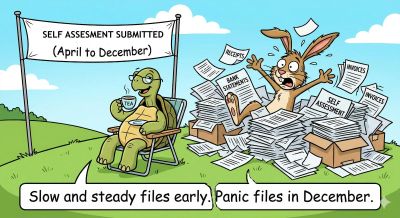
As you’ll see in our cartoon this month, waiting until December to send us your invoices is a bit like trying to board a flight while the plane is already on the runway, stressful for you, and a cardio workout for us! While the Self-Assessment season technically runs until the end of the year, your future self (and your very tired accountant) will thank you for sending those records over now. Let’s swap the "December Dread" for some "April Action."
Grab a tea, settle in, and let’s get your finances spring-cleaned!
Warm regards,
Net Accounting Ltd
HMRC has launched a call for evidence on the taxation of stablecoins, running from 26 March 2026 to 7 May 2026. It seeks input from investors and professionals on whether to reform the current treatment, where stablecoins are taxed as general cryptoassets, to reduce administrative burdens and accommodate their potential use in future wholesale and retail payments.
Online filing exclusions for 2025-26 tax return
Online filing exclusions for 2025-26 tax returns (covering the year to 5 April 2026) arise when HMRC systems cannot process specific complex scenarios, requiring a paper return by 31 October 2025 to avoid penalties. Common exclusions include exceeding 5MB for attachments, specific trust/estate complexities, or certain pension/loss calculations.
HMRC is set to take action against director's loan accounts (DLA)
A Director's Loan Account (DLA) serves as a documentation of funds exchanged between a limited company and its director(s). In a comprehensive consultation, HMRC intends to impose stringent reporting obligations on director's loan accounts and loans to connected companies by participators. This initiative aims to address the substantial £14.7 billion tax gap for small businesses, which reached an unprecedented level in 2024, accounting for 40% of the corporation tax liabilities of small businesses.
Elimination of tax deductions for unreimbursed homeworking expenses
From 6 April 2026, employees can no longer claim Income Tax deductions for additional household costs incurred while working from home. They can still claim for the previous four tax years and employers can reimburse eligible costs tax-free.
Newsletter March 2026

March 2026
Spring has finally "sprung," but as Chancellor Rachel Reeves delivered the Spring Statement on March 3, 2026, it felt more like a persistent frost. While the government preached "stability," for SMEs and self-employed ones, that mostly means their income tax thresholds remain frozen until 2031. It turns out that "predictability" is just code for "fiscal drag," the gift that keeps on taking.
March 2026 has been a month of central developments, dominated by more than just the Chancellor’s briefcase. The escalating conflict in the Middle East is no longer just a headline; it is a direct hit to the UK economy. With energy prices surging and shipping routes disrupted, the OECD has warned that Britain may face the sharpest inflationary sting among G20 nations.
As if global volatility weren’t enough, HMRC has suggested a new way to stay "close." A new consultation proposes mandatory, detailed reporting of almost every transaction between close companies and their shareholders. Whether it’s a dividend, a loan, or an asset transfer, HMRC wants a front-row seat. Think of it as a mandatory pen-pal scheme, only with more spreadsheets and significantly fewer postcards.
Elsewhere in this newsletter, we break down the April 2026 dividend tax hikes and the new National Living Wage rates. In this rapidly changing environment, we are here to help you navigate the complexities of the UK market within its wider global context.
Warm regards,
Upcoming State Pension age changes
Upcoming State Pension age changes
From 6 April 2026, the State Pension age will increase from 66 to 67 years, phased in over two years for individuals born between 6 April 1960 and 5 March 1961. Employers should verify employees' State Pension ages using the calculator and update National Insurance rates accordingly. They must report original and updated category letter information separately until the tax year ends.
Rachel Reeves initiates a widespread tax increase targeting pensioners
Rachel Reeves initiates a widespread tax increase targeting pensioners
Chancellor Rachel Reeves' decision to increase the number of pensioners subject to income tax, is predicted that the count will rise from 6.7 million in 2021 to 10 million by 2030/31.
HMRC suggests broader reporting for transactions involving shareholders of close companies
HMRC suggests broader reporting for transactions involving shareholders of close companies
This consultation, led by HM Revenue and Customs (HMRC) and HM Treasury (HMT), seeks stakeholder views on proposals to mandate reporting of transactions between close companies and their participators to HMRC, open until 10 June 2026. This includes sales, dividends, and loan reclaims. The goal is to enhance transparency, improve tax compliance, and reduce the small business Corporation Tax (CT) gap, which currently stands at £14.7 billion for the 2023-2024 tax year, representing 40.1% of the theoretical CT liability in this sector. Close Company is a company controlled by five or fewer participators, or any number of participators who are directors. Mostly small, family-owned or owner-managed businesses.
Numerous employers have been penalized for unlawfully underpaying their employees
Numerous employers have been penalized for unlawfully underpaying their employees
The UK Government has named 389 employers nationwide for failing to pay the National Minimum Wage to tens of thousands of workers. This latest enforcement round highlights the government’s commitment to protecting workers’ rights and ensuring fair pay across all sectors. The establishment of the Fair Work Agency marks a critical step forward in streamlining enforcement and safeguarding workers’ rights.
Changes to National Minimum Wage
Changes to National Minimum Wage
Across the board, the National Living Wage will go up to £12.71 an hour for workers aged 21 and over at the start of April.
Dividend income tax rate to rise by two percentage points
Dividend income tax rate to rise by two percentage points
Dividend income tax rates will increase by two percentage points for most taxpayers starting 6 April 2026, with basic rate at 10.75% and higher rate at 35.75%, while the top rate remains at 39.35%.